


Words by Loureen Murphy
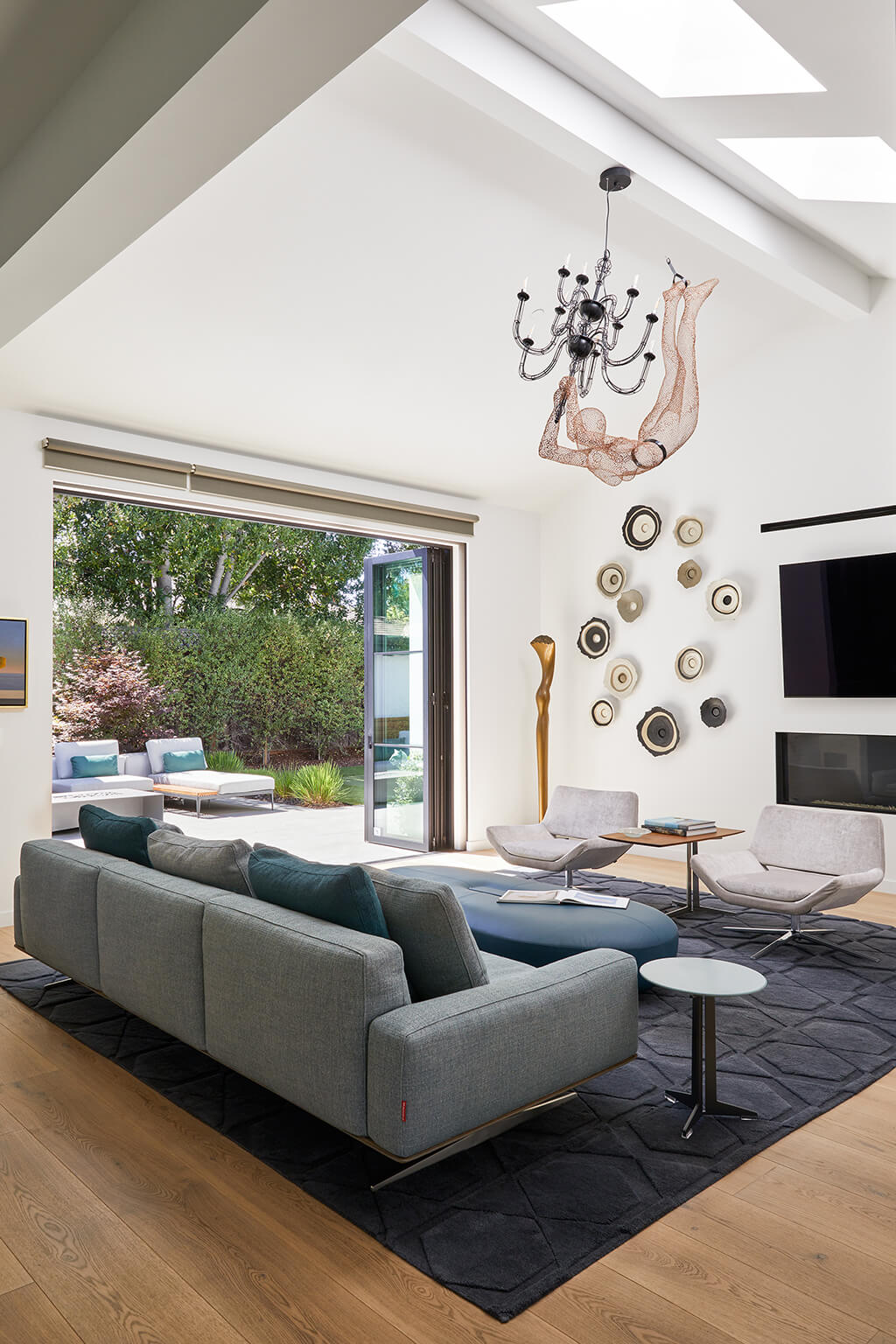
In a house on a quiet Los Altos street, a woman swings from the great room chandelier. In the nearby hallway, another dangles a lyre on her foot, unaware of dinner guests’ admiring looks. The remodeled home’s eye-catching aesthetic exudes an exuberance infused with peace—the combined work of Michael and Daphneé Metiu of Atelier Ma and interior designer Gaye Ferrara of Ferraras Interiors.
Having clicked with the homeowners from the first interview, Michael and Daphneé reinforced and expanded on Gaye’s and the clients’ vision: Create a backdrop for art, transforming the chateau-style home into a fun, gracious place to live and host.
“It’s not often that you get clients with such a love for art and such a varied collection,” says Michael. Drawn to the Limbo Chandelier because it reminded the homeowner of her fun-loving self, she bought it with no clue where she’d use it. So when they settled on placement, Michael raised the great room ceiling, knocking out the attic framing and engineering a coffered ceiling while accommodating the existing skylights. Today, the handwoven-wire aerialist “performs” between the two skylights; at night, the chandelier lights the room.
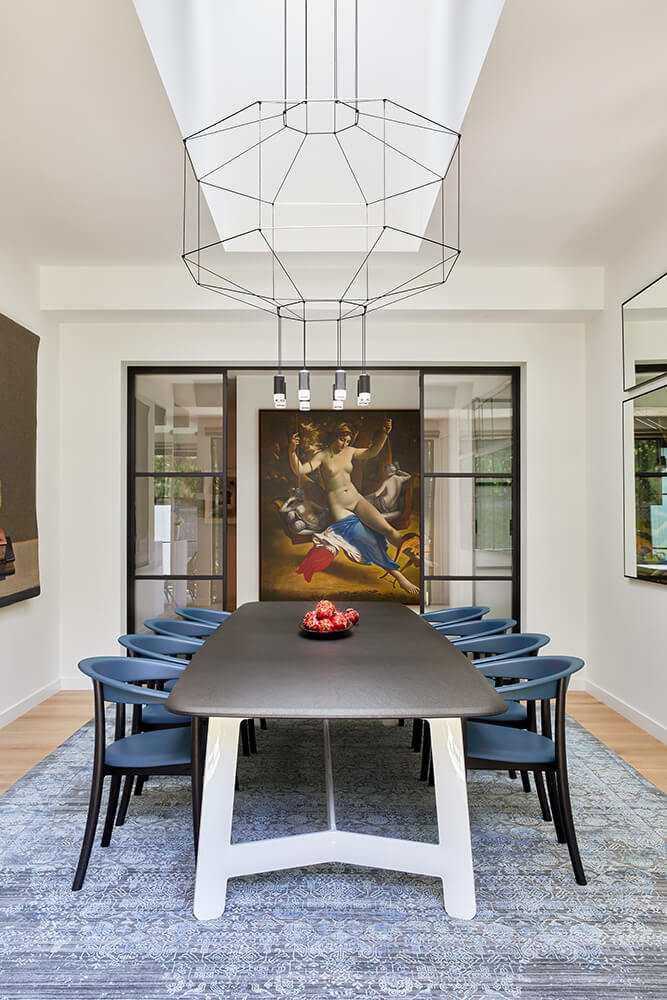
And the lady with the lute? She’s the luminous nude in Carlo Maria Mariani’s “Monument to Poetry,” which the homeowners had sold off with a previous home. At Gaye’s insistence, they bought it back, placing it opposite the dining room. Michael says it’s his favorite space in the home.
“I love a house where you can get light from three different sides,” Michael says. Here, light pours in from the side yard through the steel and glass doors, the skylights and from the light fixture. It renders a soft light without glare and creates a calm, beautiful space. They achieved this effortless look with extra framing, installed to suspend the fixture with its huge escutcheon between the skylights Michael made.
The home also features a custom Lutron lighting system that operates fixtures and shades, to set scenes. While it sounds theatrical, its modes create natural ambience for Cooking, Entertaining, Relaxing, even Cleaning.
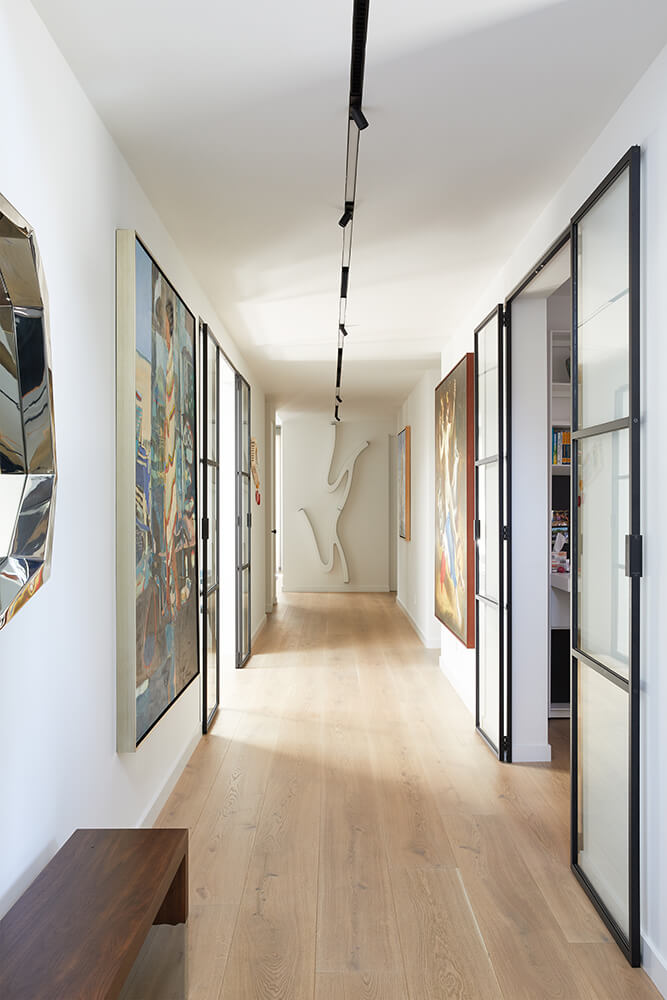
A custom fixture runs the length of the hall, illuminating the home’s gallery, flanked by a freeform neon piece, and a Mickey and Minnie work by Mr. Brainwash. Near the dining room, giant multi-colored metal Chiclets spill from a three-foot box, and various paintings bedeck the walls.
Daphneé’s preferred room, the corridor, calls for visitors to slow down and pause, rather than rush right through. Michael refers to it as the “spine” of the home, delineating the private spaces—bedrooms and offices are on one side, public rooms on the other—and creating a grounding balance in an otherwise open floor plan.
In addition to staging their prized artworks, the homeowners requested more green space and greater connectivity to the outdoors. Light-loving Michael says the size of the house enabled them to use a lot of glass corners and bifold doors. From the bar between the great room and the dining room, guests can sip aperitifs to the soothing sight and sound of the water feature that Daphneé designed. Its contrasting shades of slate slabs invite the eye, and the gentle spillway invokes serenity. Guests can step through the doors and use the fountain as a bench, breathing in the natural scents of the surrounding grass and shrubs that replaced redwood mulch and pavers.
Together, Gaye, Daphneé and Michael designed the outdoor seating around the fire pit, and the wainscoting on the guest house. Daphneé and Michael also designed a pass-through from the outdoor bar to the kitchen, among other home-garden connections.
The homeowners prefer to let a house speak to them and always start fresh without bringing any furnishings from a previous home, notes Gaye. Thanks to everyone’s adaptability, creativity and artistic sense, together they utterly reimagined the house from the inside-out—without changing the roof. “Every square inch of that house I know and have thought about,” Gaye says. The result? An intentional and cohesive design with improved flow and delighted clients. The teams also credit their contractor, Pete Moffat Construction, in the project’s success. “If we could think it, they could build it,” says Michael.
Reflecting on the lovely sight lines, the energetic and calm spaces and the team’s synergy, Michael concludes, “This project captures the principles most important to us as designers.”