


Words by Johanna Harlow
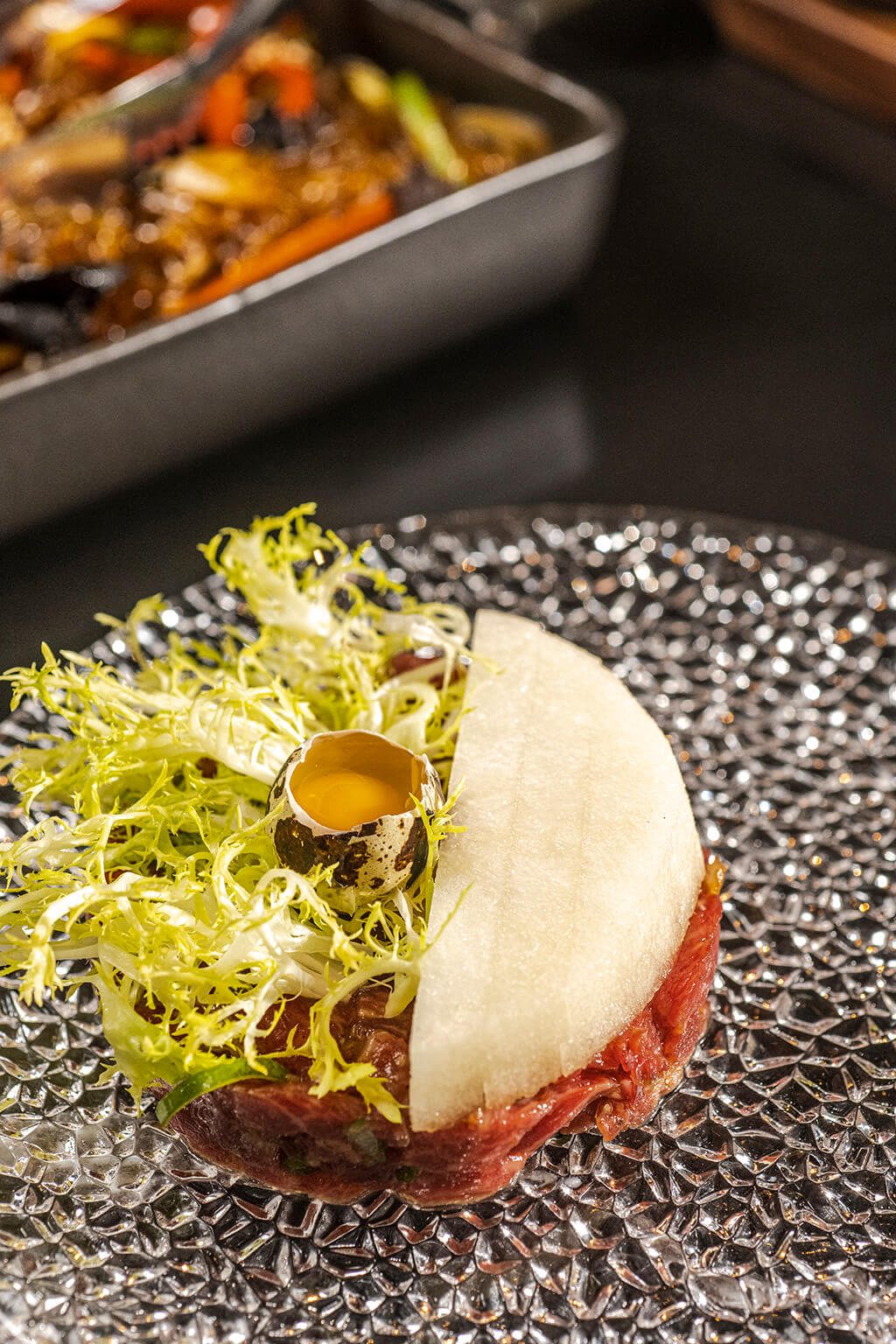
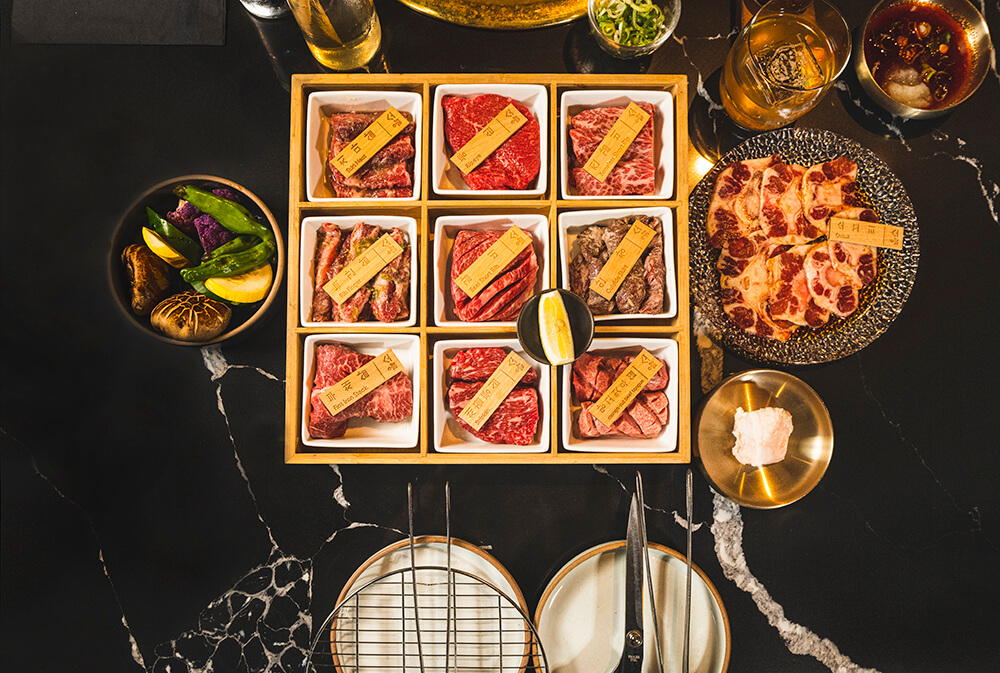
Within OLHSO’s sophisticated dining room, lamps bathe dark marble tabletops in a warm glow, while a wraparound projection on the room’s walls transports diners to Korea with a sunset scene and silhouettes of red pines, a shower of flower petals, stone lanterns and a Buddhist temple. Black-clad servers whisk around this upscale Korean barbecue restaurant, ferrying fresh cuts of meat in segmented boxes to the tables and cooking the meat over the built-in grills as sizzling sounds and savory aromas fill the air.
In Korean, OLHSO translates to “That’s right,” says co-owner Jay Shin, who handles the San Mateo restaurant’s strategy and business side. “It’s like an exclamation mark when you have great food or you meet the right people.” He adds, “If you take out each character separately, it means ‘every part of the beef.’” Though they also serve pork and noodle dishes like japchae and bibim-naengmyeon, the cow is king here. Over the course of their meal, diners can experience most of the main cuts of beef, from tongue to tail.
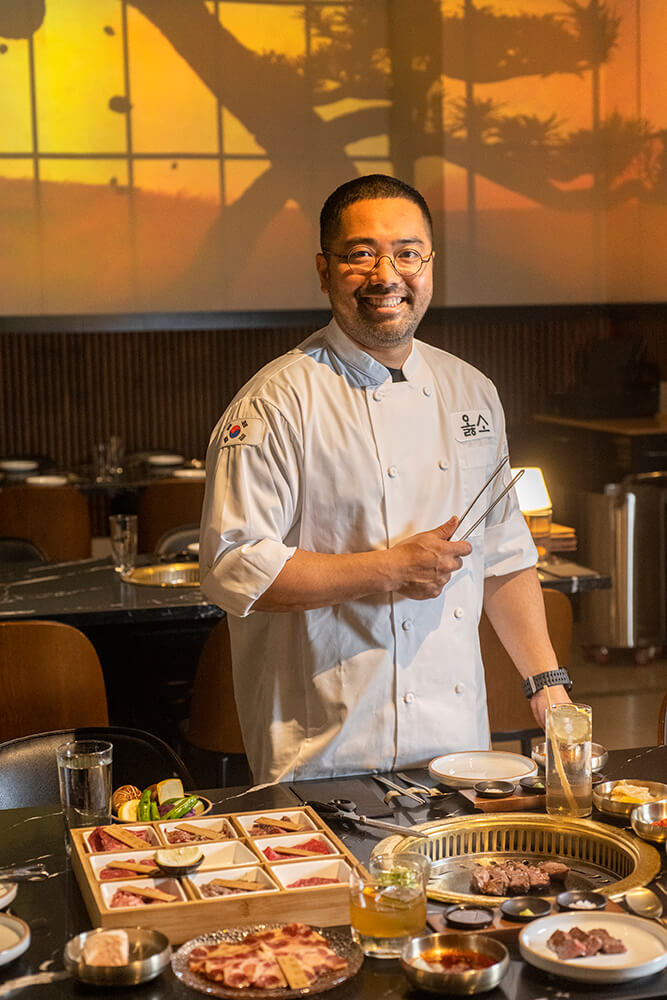
Jay has joined forces with Chef Han Sungil to make OLHSO shine. Long a fan of Han’s culinary prowess, Jay explains that Han is well-known in Korea and has run 19 restaurants from Seoul to Jeju Island. He’s made more than 20 TV appearances and his Ushiya was identified as a “must-visit Korean beef BBQ restaurant” on Wednesday Food Talk. “I was a watcher of that show many years ago,” Jay explains. “That was the only TV program you couldn’t bribe. You couldn’t throw money to be on that show. They were very strict on that.”
As a teen, a conversation Han had with his mother was pivotal to his future career path. She pointed out that book smarts weren’t his strength. Would he consider pursuing sports or cooking instead? Han agreed to attend culinary school, but found the lessons uninspired. They taught what already worked, not what truly stood out. Han dared to be creative, choosing to forge his own path and find his own flavor rather than copy the latest food trends. He found a hands-on education in professional kitchens to be far superior.
While Han was starting to make a name for himself, Jay was living in Singapore—and whenever he traveled with others to Korea, he’d take them to Han’s restaurant. “Singapore is a multinational country. You have a lot of U.S. citizens over there, Europeans, Asians, Australians,” Jay explains. “So if all my people I brought to this restaurant love his food, it’s got to work in the States!”
Did Han adapt his cooking to cater to American palates upon arriving in the Bay Area? “After a lot of consideration, I wanted to keep it as authentic as possible, so I didn’t change anything from how I’ve done it in Korea,” says Han in Korean, with Jay translating. “I want to showcase it in the most authentic way.”
Easier said than done. Jay explains that the high quality of Korean beef is well-known throughout Asia—but unfortunately, it can’t be imported to the States. How did they overcome this hurdle and achieve a similar taste? “The answer is all about aging the beef,” says Han, explaining the impact that moisture levels can have on the meat.
The grilling process is also key in recreating a taste of home. At OLHSO, there are two experiences. Diners can either opt for the traditional tableside grilling or order plates cooked in the charcoal-fueled Emberhaus oven in the kitchen, which gives dishes a smoky depth that can’t be achieved with a gas grill. “If you go to Korea and Japan, most of the high-end barbecue places only use charcoal. Nobody uses gas over there,” says Jay. In contrast, “the U.S. is typically very harsh on charcoal usage in the restaurant so now you don’t get much of a charcoal flavor in the barbecue scene in the U.S.”
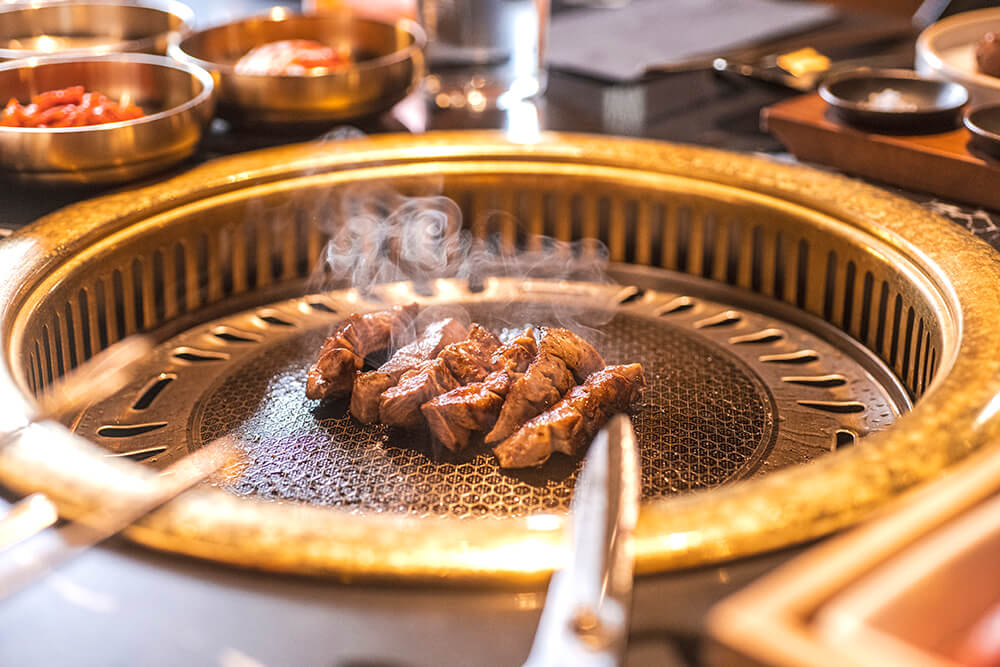
Undeterred, OLHSO worked with the fire and health departments so they could bring dishes cooked with high-grade charcoal to their guests.
The grill isn’t the only thing that imparts a distinctive taste. “I’m trying to showcase different sauces to pair with each different cut and create a variety of flavors,” says Han. “I believe each cut has its own unique taste.”
Fatty skirt steak, for example, pairs perfectly with a yuzu-wasabi sauce that cuts through the greasiness. Beef tongue is highlighted by a green scallion sauce, while the short ribs are sweetened with plum sauce. Though Han’s food is proudly and authentically Korean, the Chinese and Japanese ingredients in his sauces lend a refreshing, contemporary appeal. “I’ve spent time working with Japanese cuisine, and that experience naturally shaped how I think about flavor,” says Han. “Korea and Japan are neighboring countries, so there’s always been some exchange between the two, but now I’m really focused on developing and expressing my own Korean style.”
Not only does OLHSO keep things contemporary, it boldly strides into the future. The brand has launched a robotic food truck where the driver is the only human on board. Orders are cooked on the go as the truck calculates the distance to the destination. When the timing is right, robot arms whisk ingredients from the fridge into woks that look like dryers on a spin cycle. They’re all programmed with Han’s original recipes and strive for that perfect touch of char.
Futuristic as all this may sound, Han’s favorite part of his job is very human. As the chef considers what he loves most about what he does, he smiles and answers simply: “Drinking and talking with customers!” Then he rolls up his sleeves and returns to the kitchen.
Craveable Kimchi

Kimchi, a signature Korean classic, has a place of honor on the OLHSO menu. “We have hundreds of different types of kimchi in Korea. Whereas here, if you talk about kimchi, they only think of one,” says Jay. OLHSO offers the familiar red kimchi with cabbage as well as a white kimchi with the spicy chili paste rinsed off. The restaurant also serves radish and romaine varieties.